
Optimization of financial workflows using Lean Six Sigma
Set up KPIs, enhanced efficiencies while ensuring IPSAS compliance and staff empowerment through SOP development.
Catholic Relief Services (CRS) is one of the oldest and most impactful development partners in Ethiopia.
The organization has made significant strides in delivering much needed aid to multiple regions of the country.
CRS is responsible for disbursing millions of Dollars in aid per year. As such, it needed to streamline their operations in order to efficiently cooperate with its local partners.
iWork was recruited to come up with a solution to optimize workflows and make sure that donor money was flowing efficiently.
The work started with looking through current workflows using available flowcharts and updated operational documents. Our team also conducted interviews and sent surveys to see if the ‘on the ground’ workings matched the operational realities.
Through this process, our team discovered:
- Workload fragmentation where each section (disbursement, liquidation, program finance, records) operated independently with non-existent systems integration.
- Excessive paperwork where almost all transactions are manual. Payment vouchers, travel advances, and payroll among others involve 6–10 signatures from start to end per operational request.
- Software limitations:
- Peachtree (Sage) license has expired.
- InfoPath, formerly used for electronic requests, is still being used for the payment request format. Furthermore, this software was discontinued by Microsoft in 2016.
- Excel is the default tool but is offline, uncollaborative, and prone to error.
Output: A detailed report with preliminary recommendations.
Our team got straight to work in crafting a purpose built solution for CRS’ persistent operational bottleneck, with a focus on the financial workflow, directly tying them to local donor partners.
To see what fits CRS’ level of organizational expectancy best (and donor requirement), we had to work in a tight frame while making sure that we were utilizing all of the available tools at hand.
iWork ran a pilot test to conduct preliminary results to:
- Focus on certain ‘sub-workflows’ to understand user engagement (Ex: Staff Per-Diem request).
- Test functionality, logic, and user adoption of SharePoint + Power Automate forms.
- Train staff on form use, submission, review, and approval processes through Teams.
- Identify pain points, change management issues, and institutional barriers to adoption.
- Assess which roles may need to shift, evolve, or phase out as part of the digital transition.
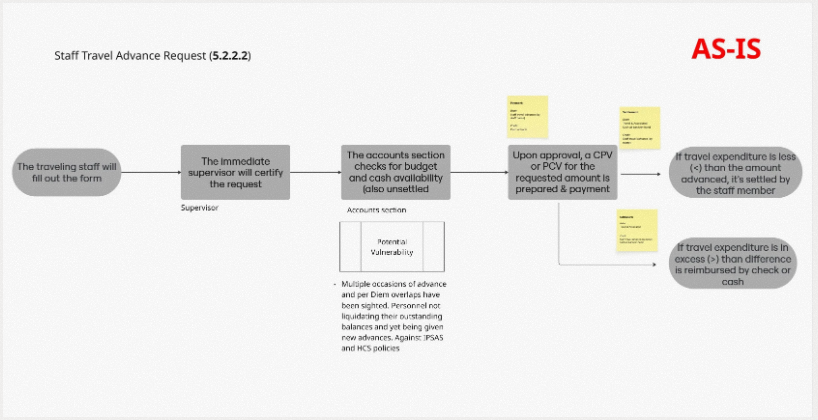
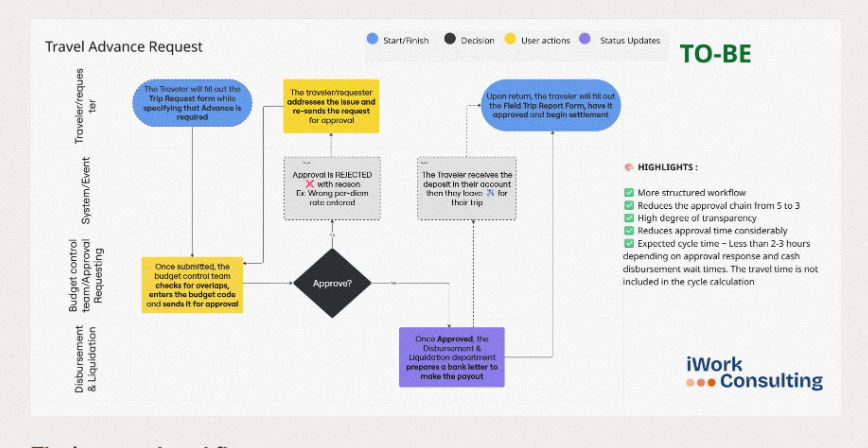
The pilot showcased a steep learning curve for the staff and highlighted a persistent reliance on manual and Excel workarounds.
Overall, iWork understood the focus to be more on change management rather than just enforcing digital rules.
The learnings from the pilot test were pivotal in the implementation stage.
Project champions were chosen, each sharing accountability of the transformation brought by the new workflows. Management was regularly updated and informed of the progress as more and more sub-workflows were digitized.
- Champions were empowered as first-line support, running weekly feedback sessions and peer mentoring to reinforce new habits.
- Kaizen and 5S practices were introduced to encourage staff to continually question inefficiencies, simplify processes, and maintain digital hygiene.
- All SOPs were issued with a revision history log and training on how to update them. This ensures that improvements made after the consultancy can be captured, standardized, and communicated across the organization.
- By making SOP maintenance and feedback loops part of everyday practice, CRS is better positioned to sustain the reforms and evolve them as needs change.
- KPIs were also established in order to set benchmarks for future process monitoring and improvement.
CRS went from a manual, fragmented and low-transparency financial workflow to a more structured, auditable and scalable version, empowering staff, management and donor partners.
The organization now has the tools, capacity, and early successes to sustain its financial transformation.
The new digital workflows and dashboards provide leadership with visibility and accountability mechanisms that did not exist before. Champions and trained staff are in place to support adoption, while the revision-enabled SOPs and compliance trackers ensure improvements can evolve over time.
Want a result like this?
Tell us where you’d like to create value. We’ll follow up with a focused first conversation.